
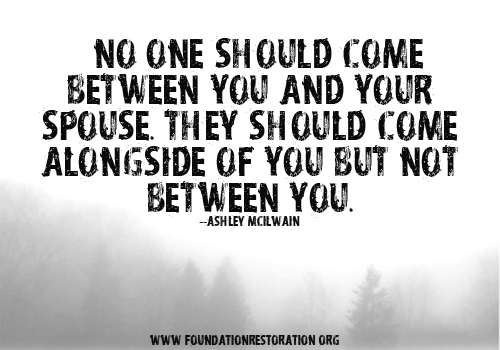
The Importance of In-laws

As a child, we lived close by both sets of grandparents and got to know each. Most every Sunday afternoon we went to visit my mother’s parents and we got to visit with Aunts, Uncles, and cousins too. I got to see my father’s mother about every day since she lived above the Drug Store where my father worked. So for me, having close ties with grandparents (in-laws) was important. From what I could tell my parents got along well with both sets of parents.  

When my husband and I first met in college, I was only looking for someone fun to do things with, I was not interested in finding my spouse. Of course, the Lord had other plans and here we are 34 years and 5 children later. In that time I have had the opportunity to get to know my in-laws pretty well. Funny thing though, when we were becoming more serious in our dating, my parents, who were not members of the Church, encouraged the relationship and offered to mail me my grandmother’s rings to use for my engagement and wedding ring. His parents, members of the Church, were not too excited about the idea of our getting married before he graduated from college. They were afraid that he would not finish. He more than finished college, after 15 years of marriage and 5 children my husband graduated with an Ed.D. [Doctor of Education] in Institutional Management. By then my father-in-law and both my parents had passed away and did not get the chance to celebrate at the party we had for him.

According to James M. Harper and Susanne Frost Olsen, “Parents who can work toward inclusion of a new son- or daughter-in-law and who show increased love and support have the best relationships with their married children and more influence in the lives of their grandchildren” (p.330). Early on we lived in Provo, Utah. My parents lived in Pennsylvania and his parents lived in Southern California. So we spent more time with my in-laws than we did with my parents. Of course, we kept in touch via phone and mail with my parents until we had been married for at least 4 years. By that time we both had better-paying jobs and could afford to travel on occasion. We did visit with my in-laws at least once-a-month after we moved out to our own apartment in Southern California. After children came along we tried to visit more than once-a-month so our children would at least know one set of grandparents well. It was hard to go visit them because they did not have a high chair or a playpen for our children so we would pack everything up and transport it to their house for a visit of a few hours. One time, I insisted that they come to us. After all, they only had to drive themselves to our apartment and not bring all the equipment with them. My father-in-law said that it was too far, I said that it was the same distance for us to travel to them. I think he was joking, at least I hope he was.

My mother-in-law is the best, she has been very supportive of our family. She has followed the five suggestions that every in-law should avoid as given by Gloria Horsley. “They are giving advice, criticizing, pinning down children-in-law as to the specific reasons they are missing a family event, criticizing or taking over the disciplining of grandchildren, trying to control everyone and everything including children’s beliefs, and unclear and indirect communication” (p. 332). We have gone camping with her and to Hawaii together. She has babysat for us and hosted family dinners at her home. Now that she is older and her health has begun to fail, we have had the opportunity to care for her full time. But only with time, contact, and communication are those relationships built.


Harper, J. M. & Olsen, S. F. (2005). “Creating Healthy Ties With In-Laws and Extended Families.” In C. H. Hart, L.D. Newell, E. Walton, & D.C. Dollahite (Eds.), Helping and healing our families: Principles and practices inspired by “The Family: A Proclamation to the World” (pp. 327-334). Salt Lake City, UT: Deseret Book Company.


Horsley, G. C. (1997). The In-law Survival Manual: A Guide to Cultivating Healthy In-law Relationships (New York: John Wiley & Sons).




Happiness in Family Councils

When our children were growing up we made an effort to have, at least, a monthly family council. It was during these meetings that we went over the schedule, we went over assignments for Family Home Evening, we taught about tithing and other principles and doctrines. On occasion, that was really the only time that we all were together during the week. But there is one council, I think, my husband and I could have used more to our advantage and that is the couple council or the “executive session” as Dr. Richard B. Miller calls it in his 2008 address, “Who is the Boss? Power Relationships in Families”.  

The idea of councils is not new. Joseph Smith, when organizing the first high council of the Church, described his actions, “I then declared the council organized according to the ancient order, and also according to the mind of the Lord” (p. 40). Councils were even used when organizing the heavens and the earth as found in the Pearl of Great Price in Abraham 5: 3 “And the Gods concluded upon the seventh time, because that on the seventh time they would rest from their works which they (the Gods) counseled among themselves to form; and sanctified it. And thus were their decisions at the time that they counseled among themselves to form the heavens and the earth.”

Elder M. Russell Ballard explains, “I don’t know that it is possible for any organization to succeed in the Church…without adopting the genius of our Church government. What is that? As I conceive it, the genius of our Church government is government through councils” (p. 44). The saying goes, two heads are better than one, and councils are a great way to take advantage of those two or more heads. One idea of councils that particularly impressed me was a statement by Elder Rulon G. Craven, former executive secretary to the Quorum of the Twelve Apostles. He says, “I have noticed that each of the Brethren is not so much concerned with expressing his own point of view as he is with listening to the point of view of others and striving to create a proper climate in the Council meetings. They are sensitive to one another’s thoughts and rarely interrupt one another during their conversations. During discussion they do not push their own ideas but try to determine from the discussion what would be best for the kingdom” (p.47). Of course, this is description is in relation to general Church matters. Yet the same principles or concepts could be applied to any family council.

With Mom and Dad at the helm, families can council where everyone is heard from, all ideas are appreciated, without ridicule, and an agreement is reached that leaves everyone happy. I know that we missed the mark on some of the points made in Elder Craven’s description, yet I feel everyone did get a voice in many of our decisions, especially when planning vacations. The kids came up with some of the best ideas, such as when our oldest graduated from high school she suggested that we go to Washington D.C. That was a great trip. Not only did we tour Washington D.C. but we also got to visit with my family in Pennsylvania and the Sacred Grove and Palmyra in New York. I would not have been able to plan that on my own, so glad we listened to the kids and their ideas. That is what I feel is the best part of the wisdom of councils. 

The Thompson Family in New York City

Ballard, M. Russell. (1997). Counseling with Our Councils, Salt Lake City, UT. Deseret Book.

Miller, Richard B. Ph.D. “Who is the Boss? Power Relationships in Families.” BYU Conference on Family Life, Brigham Young University, March 28, 2009.


Fidelity in Marriage

For most folks, myself included, the topic of sexual intimacy is a sensitive subject. And as a follower of Jesus Christ, I want to keep the commandments, of which sexual purity is one. When kneeling at the marriage altar, I find it interesting that one moment you and your finance are not married and then next you are now husband and wife. With that change full expression of the love shared is now allowed. Prior to marriage, we are told to save our virtue for our spouse; that the powers of procreation are to only be engaged after lawful marriage.

In our readings this week we are reminded of just how sacred the power of procreation is and how, within the bonds of matrimony, sexual intimacy is a way to not only bring children into the world but to also keep the bonds of matrimony strong. We also learned that fidelity is more than of just a physical nature. True fidelity involves the mind, heart, and body of a person.

We should be friends with our spouse but we may also develop friendships with others outside of our marriage. This is not necessarily a bad thing on its own, however when a friendship creates thoughts and feelings that are not in keeping with the marriage covenants that have been made, then a problem fidelity could exist. Kenneth W. Matheson, a professor at Brigham Young University stated, “Physical infidelity is only one of the many temptations Satan uses to break up families and marriages. Emotional infidelity, which occurs when emotions and thoughts are focused on someone other than a spouse, is an insidious threat that can weaken the trust between a couple and shatter peace of mind” (p. 3). I have a friend who experienced this exact situation. She became friends with a man she met at school. Her husband was not happy with the friendship but other than complaining, he did not work on building their relationship. So she turned toward her “friend” and eventually left her husband and got a divorce. This couple had been married for at least 20 years and had a Temple marriage.

How do we prevent infidelity in any form from happening? I would like to share some of the suggestions provided by H. Wallace Goddard in his book Drawing Heaven into Your Marriage. He provides 10 ways to prevent or overcome the temptation of infidelity. I would like to share seven.

  1. Do not allow the seeds of lust to germinate. Do not look on another woman or man with lust.
  2. Never make excuses to spend time alone with a person of the opposite sex who is not your spouse.
  3. Take responsibility for the messages that you give. You do not have the right to be “cute” or flirty with anyone but your spouse.
  4. Do not allow your heart to dwell on anyone. Push daydreaming of any person but your spouse out of your mind.
  5. Spend more enjoyable time with your spouse. Find ways to improve your marriage.
  6. Renew your spiritual efforts. Turn to the Lord in prayer. Ask for strength to put temptation out of your mind.
  7. Celebrate the sweet gift of companionship. Each of us should rejoice in the sacred gift of spousal trust (p. 87-89).

By applying these suggestions and recommitting ourselves to our spouses and our marriages temptation can be overcome and improvement can be made.

Interestingly, much has been said, even in the scriptures about the importance of marital relations. In Genesis 2: 24 it states, “Therefore shall a man leave his father and his mother, and shall cleave unto his wife: and they shall be one flesh”. Brent A. Barlow continues this thought by quoting President Spencer W. Kimball, twelfth president of the Church of Jesus Christ of Latter-Day Saints, “Sexuality is a beautiful power given to mankind from God. ‘The Bible celebrates sex and its proper use, presenting it as a God-created, God-ordained, God-blessed. It makes plain that God himself implanted the physical magnetism between the sexes for two reasons: for the propagation of the human race, and for the expression of that kind of love between man and wife that makes for true oneness. His commandment to the first man and woman to be “one flesh” was as important as his command to “be fruitful and multiply.” (Quoting Billy Graham, Ensign, May 1974. p. 7.)’ (p. 1).

I have to admit that I have not paid as much attention to this aspect of my marriage as perhaps I should. I think that perhaps both my husband and myself could use to go back to school and learn more about the importance of having a stronger bond through physical expression.


References:

Barlow, Brent A. https://byui.brightspace.com/content/enforced/23923-FTC_hanse229/Course%20Files/Twain%20Shall%20Be%20OneThoughts%20on%20Intimacy%20in%20Marriage.pdf?_&d2lSessionVal=F4TPXua50Log2P7PIToPIV5Cm&ou=248791.

Goddard, H. Wallace, Ph.D. (2007) Drawing Heaven into Your Marriage, Powerful Principles with Eternal Results. Fairfax, VA: Meridan Publishing.

Matheson, Kenneth W. https://www.lds.org/ensign/2009/09/fidelity-in-marriage-its-more-than-you-think?lang=eng.

(748)